

If you manage brand color consistency or operate a printing facility, you already rely on G7 for reliable gray balance and neutral tonality across processes. In early 2024, PRINTING United Alliance introduced G7+ as the next evolution of the specification. By 2026, G7+ training, expert certifications, and system certifications are fully available, and many printers and brands are evaluating the upgrade.
This post explains the practical differences between G7 and G7+, the improvements G7+ delivers, and when it makes sense to transition—especially within a broader Print Quality Management (PQM) program that includes GMI compliance.
Quick Recap of Classic G7
G7, developed by Idealliance (now part of PRINTING United Alliance), focuses on achieving consistent gray balance and neutral tonality so that printed materials look visually similar regardless of printing method, ink set, or substrate.
It defines a Neutral Print Density Curve (NPDC) and specific gray balance targets (such as the 50C/40M/40Y midtone).
Primary goal: Shared neutral appearance across devices and substrates.
Benefits: Reduced makeready time, better proof-to-press matching, and more predictable color across offset, flexo, digital, and other processes.
Certification levels for facilities typically include Grayscale, Targeted, and Colorspace compliance, with “G7 Master” representing high achievement.
G7 has delivered strong results for nearly two decades and remains fully supported.
What Is G7+ and What Changed?
G7+ augments classic G7 with new logic, algorithms, and features while maintaining a very similar overall appearance. It was designed to perform more effectively across a wider range of printing technologies and challenging substrates without requiring major workflow changes.
Key technical improvements in G7+:
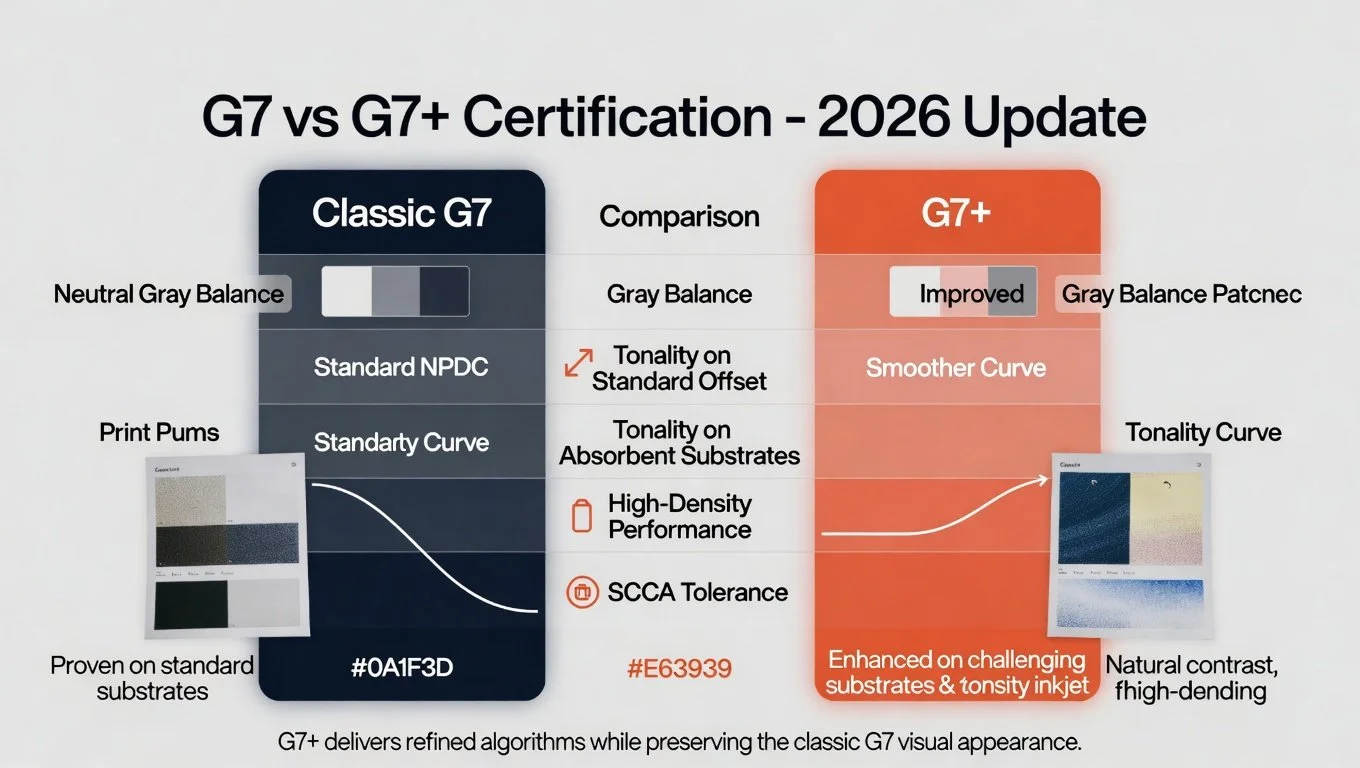
Gray Balance: Uses the same CMY triplets as G7 but applies a more technically sound algorithm. It delivers improved “shared neutral appearance,” performs better on strongly colored substrates, and is unaffected by Substrate-Corrected Colorimetric Aims (SCCA) processing in many cases.
Tonality: A completely new algorithm maintains legacy G7 behavior on standard commercial offset (e.g., GRACoL 2013 levels) but provides smoother, more natural contrast on low-density or absorbent substrates such as textiles, thin papers, newsprint, and packaging board. Flesh tones and shadows often appear more pleasing and less muddy.
High-Density Applications: Better control in high-ink-load inkjet, wide-format, and richly saturated colors, reducing banding and improving ICC profile accuracy.
Verification and QC: Enhanced tolerances and aims for G7+ Master facilities.
In everyday commercial offset or flexo work, most observers see virtually no visible difference between G7 and G7+. The advantages become clearer on non-standard substrates, high-density digital processes, or when adapting datasets to varied materials.
Side-by-Side Comparison
| Aspect | Classic G7 | G7+ (2026) |
|---|---|---|
| Core Focus | Gray balance + NPDC tonality | Same + refined algorithms for broader conditions |
| Gray Balance Calculation | LAB-based | XYZ-based with improved shared neutral appearance |
| Tonality on Standard Offset | Excellent | Virtually identical |
| Tonality on Absorbent/Thin Substrates | Can appear muddy or high-contrast in shadows | Smoother, more natural contrast (especially flesh tones) |
| High-Density Inkjet Performance | Potential banding or excessive contrast | Smoother transitions and better saturation control |
| SCCA / Substrate Adaptation | Can affect gray balance | Gray balance largely unaffected |
| Verification Tolerances | Standard | Enhanced for Master level |
| Workflow Impact | Familiar tools and files | Minor updates to calibration/verification software may be needed |
| Certification Availability | Fully supported | Active Expert and System certifications rolling out in 2026 |
When Should You Stick with G7 vs. Upgrade to G7+?
Stay with Classic G7 if:
Your work is primarily standard commercial offset or flexo on consistent substrates.
Your current G7 Master qualification is performing well and your clients are satisfied.
You prefer to minimize any software or process adjustments.
Consider Upgrading to G7+ if:
You print on varied or challenging substrates (textiles, thin papers, absorbent board, newsprint).
You use high-density inkjet, wide-format, or multi-ink digital processes where smoother tonality and reduced banding add value.
You need stronger performance when adapting datasets to different substrates via SCCA.
You want enhanced verification tolerances as part of ongoing process control.
For brands running a PQM program, G7+ provides a more robust foundation for supplier monitoring. It helps maintain tighter color consistency across global print partners without altering brand color libraries or creative workflows significantly.
How G7+ Fits into Your PQM and GMI Strategy
G7 (or G7+) serves as the technical calibration layer that supports enforceable color standards in PQM. When combined with GMI certification requirements, it helps reduce rejections, shorten makeready, and deliver repeatable results across suppliers.
At Mann & Co., we help clients assess their current setup, identify gaps, and implement the right calibration approach—whether maintaining G7 or transitioning to G7+—while integrating it into broader supplier scorecards and brand color management.
Next Steps
Review your primary substrates and printing technologies against the improvements G7+ offers.
Check with your calibration software or RIP provider for G7+ support (many systems are updating in 2026).
Evaluate your current G7 Master status and qualification timeline.
Ready to evaluate G7 or G7+ for your color management program?
Use the contact form or call us at (941) 259-2100.
Last updated: April 2026. G7+ specifications and certification programs continue to evolve. Verify current details directly with PRINTING United Alliance.